
Afraid Your IELTS or PTE Score Will Block New Zealand Skilled Residence in 2026?
For most New Zealand skilled residence applications in 2026, the principal applicant needs IELTS 6.5 or PTE Academic 58 overall. A partner or dependen…
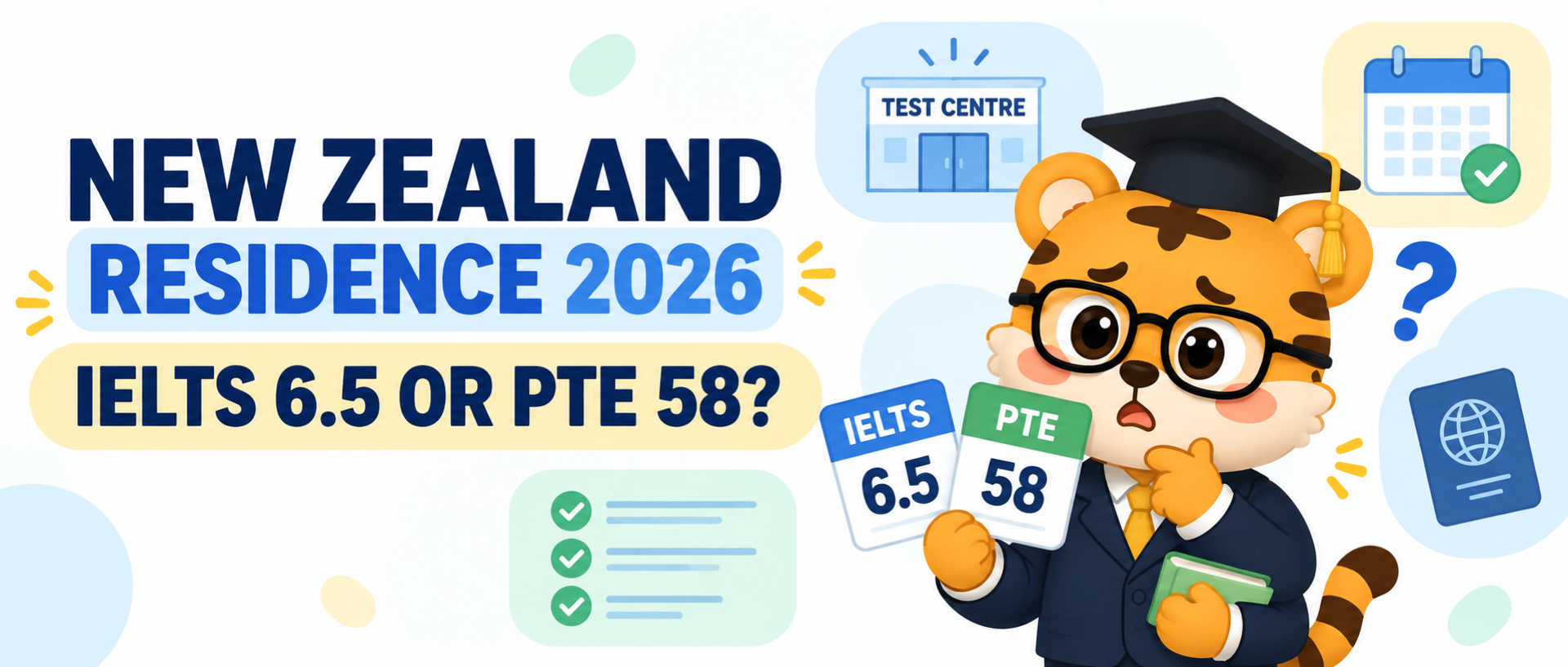
For most New Zealand skilled residence applications in 2026, the principal applicant needs IELTS 6.5 or PTE Academic 58 overall. A partner or dependent child aged 16 or older needs IELTS 5.0 or PTE Academic 36, while children under 16 have no English requirement. The test must normally be taken in person at a test centre and be no more than two years old when you apply. Some Skilled Migrant Category applicants with recognised occupational registration have a five-year validity rule from 24 August 2026. This guide covers accepted tests, family options, and a safer choice between IELTS and PTE Academic.
New Zealand calls these routes skilled residence, although many applicants casually say New Zealand PR. The group includes the Skilled Migrant Category Resident Visa, Straight to Residence Visa, Work to Residence Visa, Care Workforce Work to Residence Visa, and Transport Work to Residence Visa. English is one gate in the application, not the whole application. You still need to meet the job, health, character, and other route conditions. This guide is about avoiding the English mistake before you pay for a test.
Skilled residence has a higher English standard than other residence visas
When using an English test, the principal applicant must meet a higher minimum score than a partner or dependent child aged 16 or older. Immigration New Zealand accepts an English test, or in some cases evidence from citizenship, work, or study. A student visa score is not automatically a residence score. A university may set a different target from a skilled residence route. Do not carry your old school target into your residence plan without checking it.
IELTS 6.5 and PTE Academic 58 are the main applicant targets
For the principal applicant, the current skilled residence table lists IELTS overall 6.5 or more and PTE Academic overall 58 or more. It also lists Academic TOEFL iBT 79, B2 First or B2 First for Schools 176, and OET Grade C+ or higher in all four skills. The IELTS and PTE numbers are overall scores in this table, not a promise that every school or employer uses the same profile. Save the exact target beside the visa route. A high score does not repair an ineligible test type.
Family members have a lower score path with different choices
For a partner or dependent child aged 16 or older, the table lists IELTS 5.0, PTE Academic 36, Academic TOEFL iBT 35, B2 First or B2 First for Schools 154, or OET Grade C in all four skills. A child younger than 16 has no English requirement under this rule. The partner or older child can use accepted citizenship, work, or study evidence. They can also take a listed test or choose English lessons in New Zealand. Your family may not need to sit the same exam.
IELTS and PTE results usually last two years for this route
Immigration New Zealand says the test result must be no more than two years old when you apply. From 24 August 2026, results are valid for five years for applicants who hold a recognised occupational registration. That is a specific Skilled Migrant Category change, not a five-year promise for every residence applicant. A result that is valid for a university intake may still be too old when another residence application is ready. Put the test date, expected invitation date, application type, and possible application date in one calendar. If the plan is uncertain, a slightly later test can be safer than an impressive but aging score.
At-home IELTS and PTE tests are not accepted
The skilled residence page says the test must be taken in person at a test centre. Remote tests and at-home versions are not accepted for this evidence. This matters because an online result can look official and still fail the route check. Check the booking screen and the score report type before you pay. If a local test centre has few dates, book around your application calendar instead of waiting until your English feels perfect.
IELTS General and Academic are both listed for this residence route
New Zealand’s skilled residence list accepts the IELTS General or Academic module. Immigration New Zealand also lists IELTS One Skill Retake (OSR) among the approved test options. This gives some applicants more flexibility when they already have a study or migration plan. The route page still deserves a fresh check because acceptance details can depend on the exact instructions and result you submit. Write “IELTS General,” “IELTS Academic,” or “IELTS One Skill Retake” in your notes rather than writing only “IELTS.”
PTE Academic fits the list but PTE Core is a different test
The residence page names Pearson Test of English Academic (PTE Academic) as the approved Pearson test. It does not list PTE Core, so do not assume a PTE Core result qualifies for skilled residence. If you prefer a computer test, confirm that your booking says PTE Academic and that the test centre is approved for your use. The word Academic is small, but it can decide whether the result belongs in your file. Check the full test name again before you submit the result.
A high score does not guarantee skilled residence eligibility
Different tests use different thresholds: IELTS, TOEFL iBT, PTE Academic, and B2 First or B2 First for Schools use overall scores in this table, while OET requires Grade C+ or higher in all four skills. The English requirement is only one part of a complete residence application. Your job, qualification, registration, wage, health, and character evidence must fit the selected route. A test score cannot make an ineligible job offer eligible. Treat English as one locked box in a larger document checklist, not as the only thing that matters.
Some applicants can meet the English rule without a test
Some applicants can show English through their background instead of taking a test. Immigration New Zealand describes citizenship, work, and study evidence, including citizens of Canada, Ireland, the United Kingdom, or the United States who spent at least five years working or studying in those countries, Australia, or New Zealand. A comparable New Zealand level 7 bachelor’s degree may qualify if gained in Australia, Canada, Ireland, New Zealand, the United Kingdom, or the United States with at least two years living there while studying. A comparable level 8 or higher postgraduate qualification may qualify with at least one year living there while studying. Keep the certificate and transcript; an IQA may be needed, and “I used English a lot” is not enough by itself.
Family members have a lesson option instead of a test
If the principal applicant uses a test, the result must meet the minimum and be no more than two years old when the application is made; principal applicants cannot use the English-lesson option. A partner or dependent child aged 16 or older who misses the minimum test score may choose English language lessons in New Zealand. They choose that option when applying and pay if Immigration New Zealand approves the visa. Lessons are not a free shortcut, and they can affect the family budget and timing. A simple family table can prevent one missing result from delaying everyone.
Study and residence scores need separate checks
Many applicants start with a university requirement and later hope the same result will cover residence. Sometimes it does, but the target and evidence rules may be different. Add columns for school, student visa, employer, and skilled residence, then write the accepted test and date window under each one. This Immigration New Zealand page lists PTE Academic—not PTE Core—for skilled residence, so do not assume that a PTE Core score qualifies for this route. This boring comparison is cheaper than preparing for the wrong exam twice.
IELTS may suit you when you want a wider paper trail
IELTS can be a practical choice if you already have experience with a human Speaking test or want the General and Academic modules available for different plans. New Zealand lists both modules for skilled residence, which can help a person holding several country options. You still need to practise the exact format, especially timed Writing and the live interview. Youshow IELTS can help you train the four skills in small sessions after you write your exact New Zealand target. Use practice feedback to repair one weak skill, not to collect random templates.
PTE Academic may suit a controlled computer routine
PTE Academic can fit people who prefer speaking into a microphone, typing, and receiving computer-based feedback. It is a good choice only when the route accepts PTE Academic and your test-centre result will be available in time. Practise pronunciation, fluency, listening, reading, and typing under the same pressure you expect on test day. YoushowPTE can support a focused routine around the tasks lowering your score. The useful question is not “Which test is easiest?” but “Which accepted test lets me show my English with fewer avoidable mistakes?”
The booking checklist catches expensive mistakes
On day one, copy the official residence score and test list into your notes. On days two and three, try current IELTS and PTE Academic tasks only if both are acceptable for your route. On days four and five, repeat the weakest skill with a timer and record the mistakes you can actually fix. On day six, check your test-centre date, result timing, passport name, and two-year application window. On day seven, choose the test with the better evidence, then study it for four weeks before changing your mind again.
The full route checklist protects the 2026 application
New Zealand residence does not require you to guess between IELTS and PTE numbers. The main applicant target is IELTS 6.5 or PTE Academic 58, while partners and older dependent children have lower listed targets. Test-centre delivery, timing, full test names, and alternative evidence can change your plan. Check the current Immigration New Zealand instructions before booking and keep a copy with your notes. The score matters, but it must be accepted in the right application.
YoushowEdu
Turn information into action
Explore YoushowEdu tools and services that can support your next step.
Explore products →